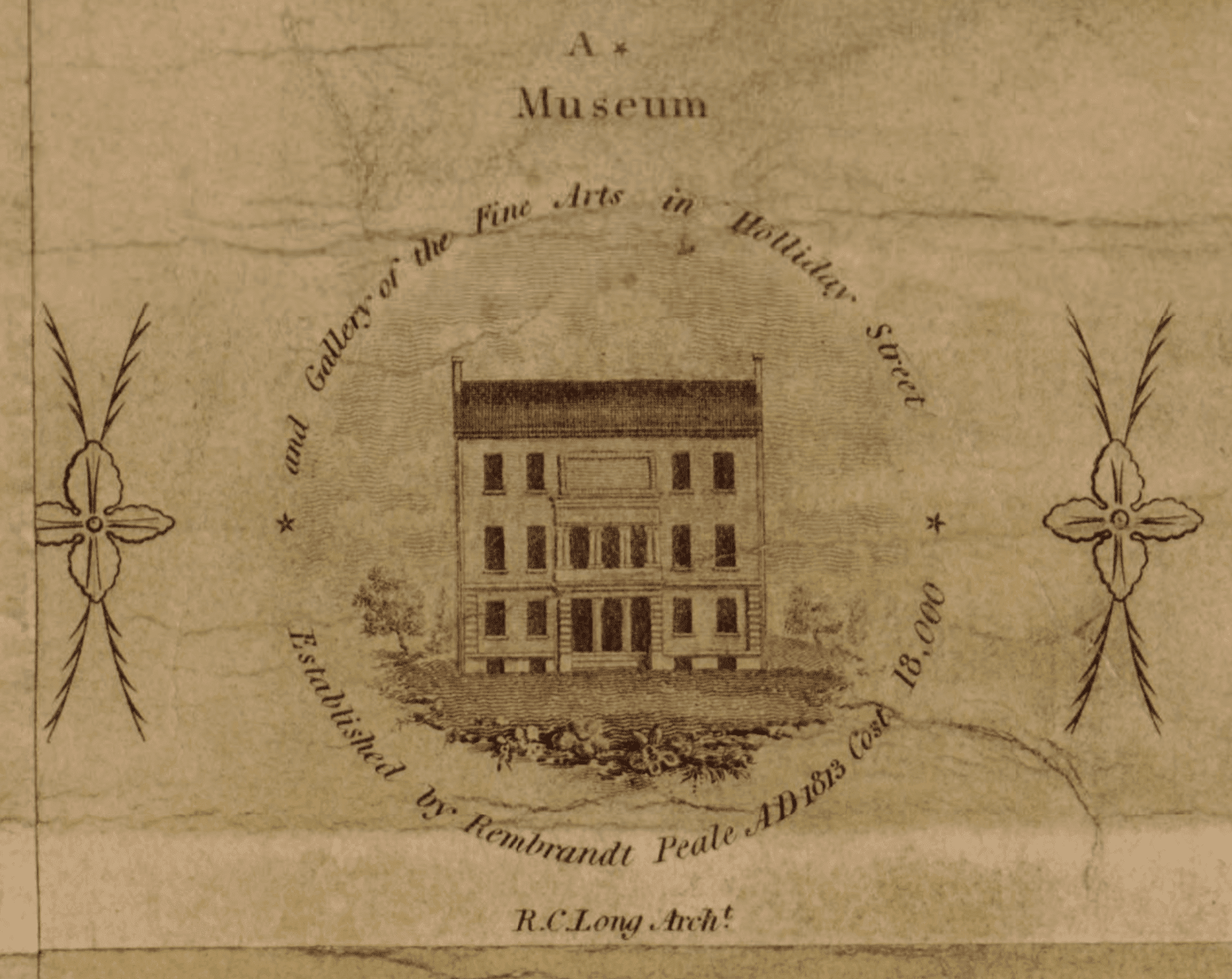
When Rembrandt Peale opened his Baltimore Museum and Gallery of the Fine Arts in August 1814, he was pursuing a bold vision: a museum devoted not only to art, but to science, invention, and public instruction. Designed by architect Robert Cary Long, the building combined the form of a refined Federal townhouse with a purpose-built gallery at the rear — the first structure in the United States created expressly as a museum.
Peale’s museum featured paintings, natural history specimens, mechanical devices, and public lectures. It was conceived during the War of 1812 and opened just weeks before the Battle of Baltimore. Financial struggles and ambitious expansion plans, however, strained the enterprise. By the late 1820s, mounting debts forced Peale and his brother Rubens to relinquish control of the property. Though the original museum was short-lived, the building itself endured — and would soon take on an entirely new civic role.
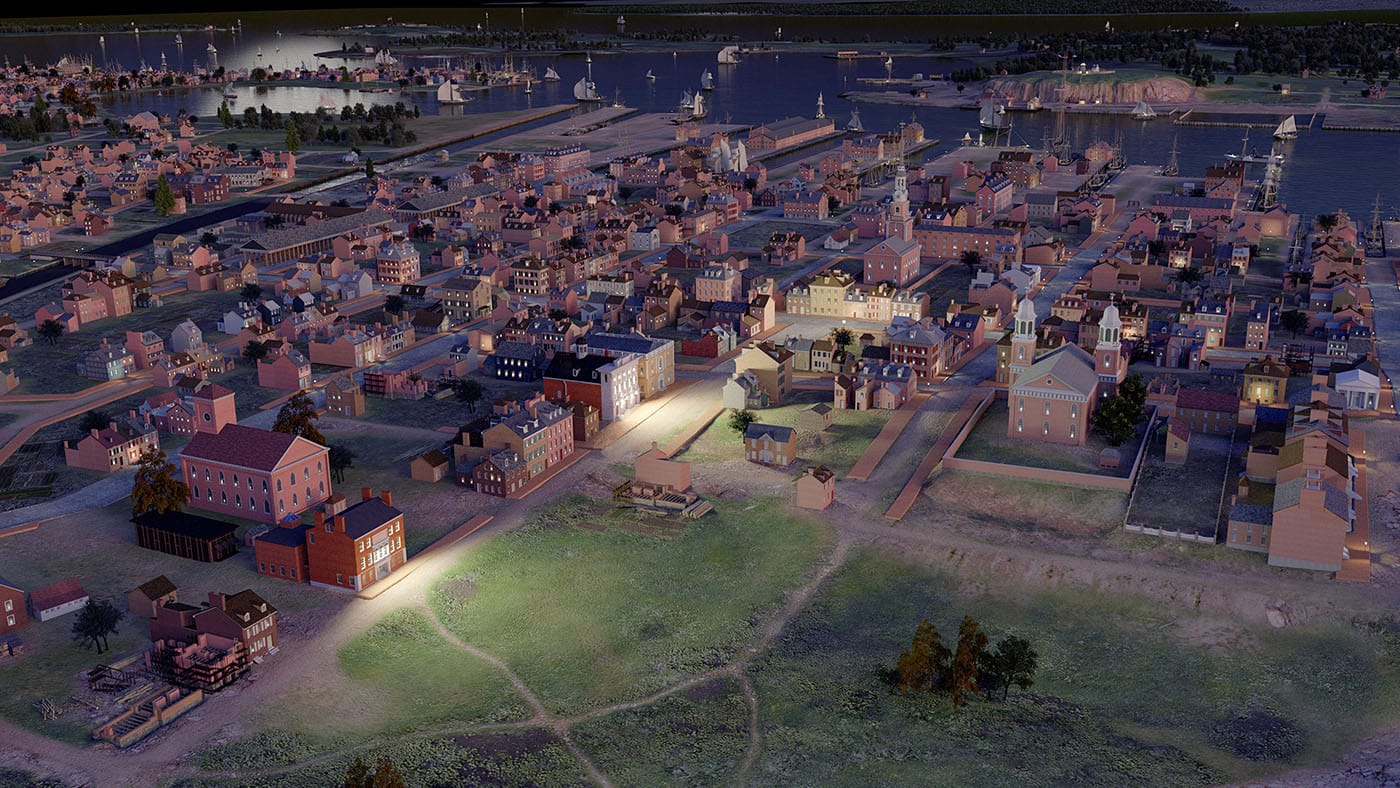
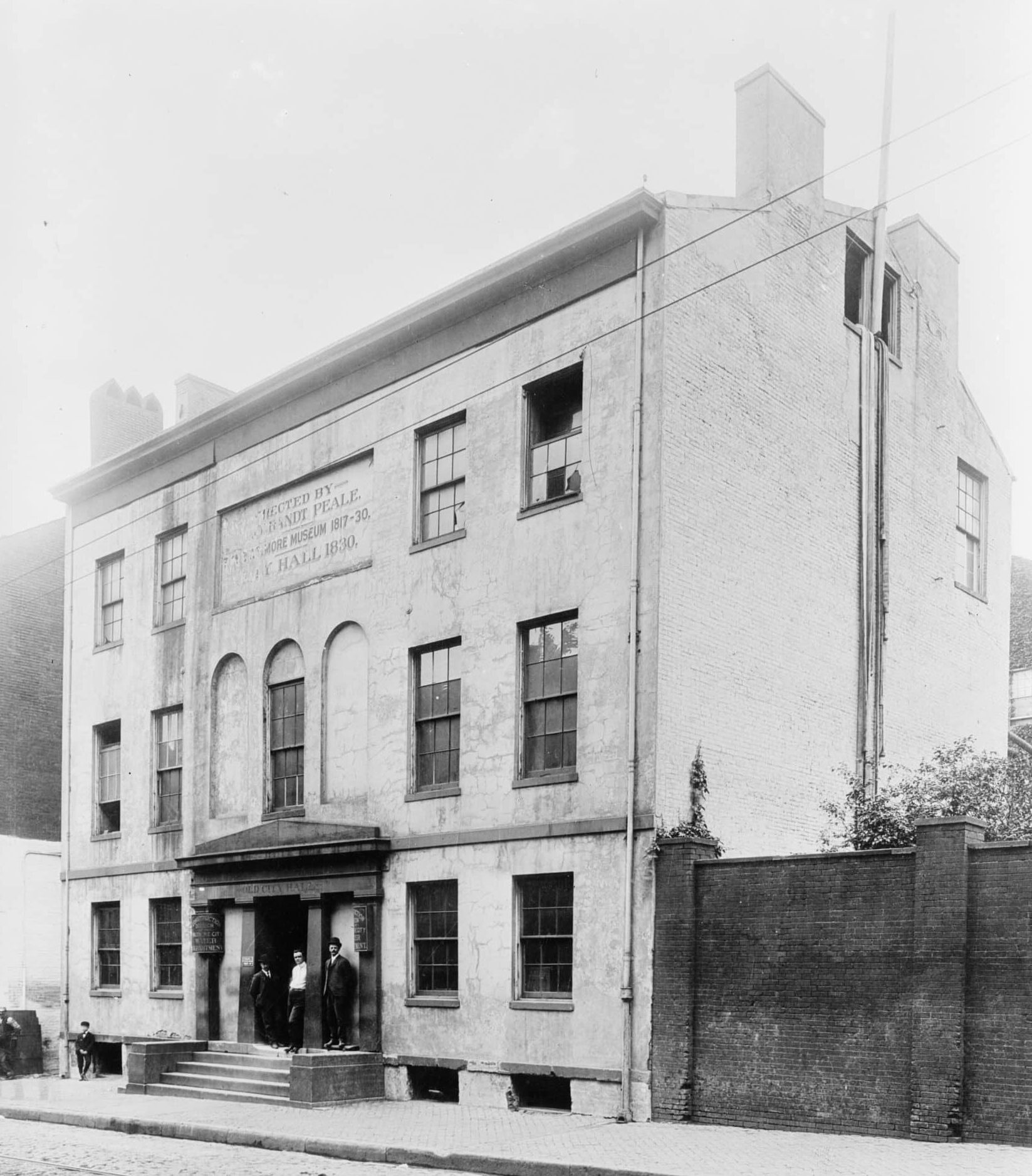
In April 1830, the Mayor and City Council of Baltimore purchased the former museum at public auction, transforming it into the city’s first dedicated City Hall. Under architect William F. Small, the structure was extensively altered: galleries became council chambers, offices replaced exhibition rooms, and the building’s exterior was adapted to reflect its new municipal authority.
For nearly half a century, this building served as the center of Baltimore’s civic life. Ordinances were debated here, mayors inaugurated, and decisions made that shaped the rapidly growing port city. Even after the mayor relocated to a larger Second Empire–style City Hall in 1875, the old structure remained in use. Its architectural pedigree and symbolic importance prevented demolition at a time when many early buildings were lost.
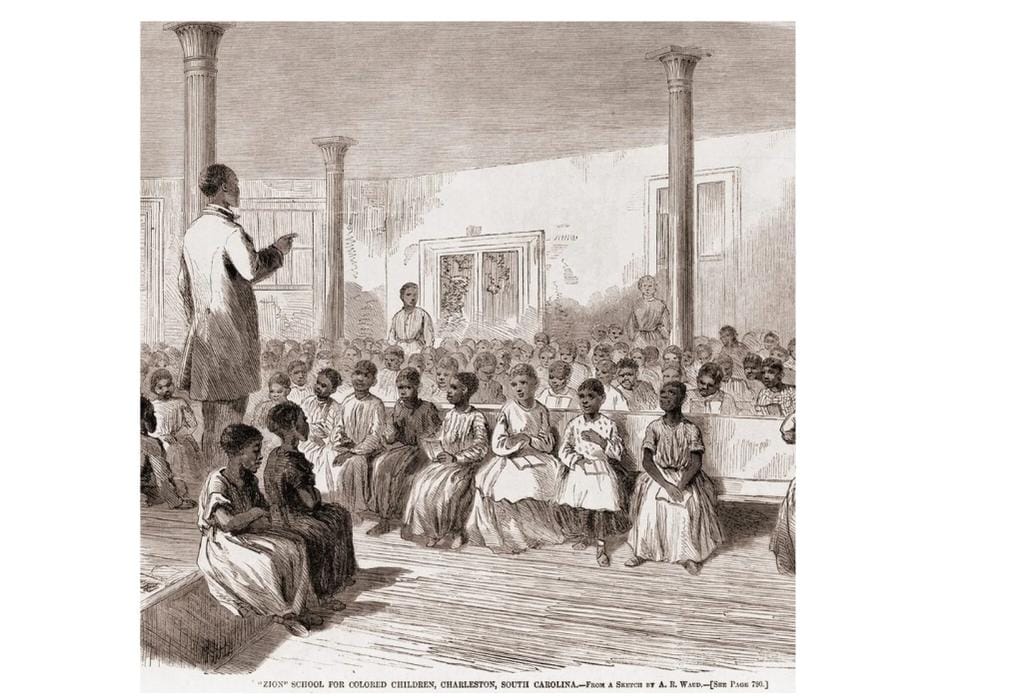
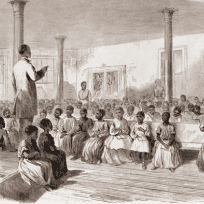
From 1878-1889, the Peale was part of the new public school system being developed in Baltimore to provide free education to African Americans in the city. Known as “Male and Female Colored School Number 1,” the building was the site of one of the first grammar schools in Baltimore’s Colored School system, and the first High School available to people of color in the State of Maryland.
Understanding the historic context from which Baltimore’s schools have been formed has never had greater urgency and importance for the Baltimore community. Up until now, the story of the ‘colored’ school system and education in Baltimore has never been comprehensively researched and presented in a way that invites public engagement.

After the departure of the Colored School in the late 19th century, the Peale building entered one of its most precarious periods. It housed a succession of private enterprises — including an organ factory, machine shops, a sign painting company, and other light industrial tenants. The surrounding neighborhood had become increasingly industrial, and the building itself was repeatedly cited as unsafe.
Despite condemnation notices and serious structural deterioration, the building survived. Its earlier identities — as the nation’s first purpose-built museum and as Baltimore’s first City Hall — lent it a stature that discouraged demolition. By the 1920s, as Baltimore prepared to celebrate its 200th anniversary, preservation-minded leaders began to reconsider the landmark’s future.
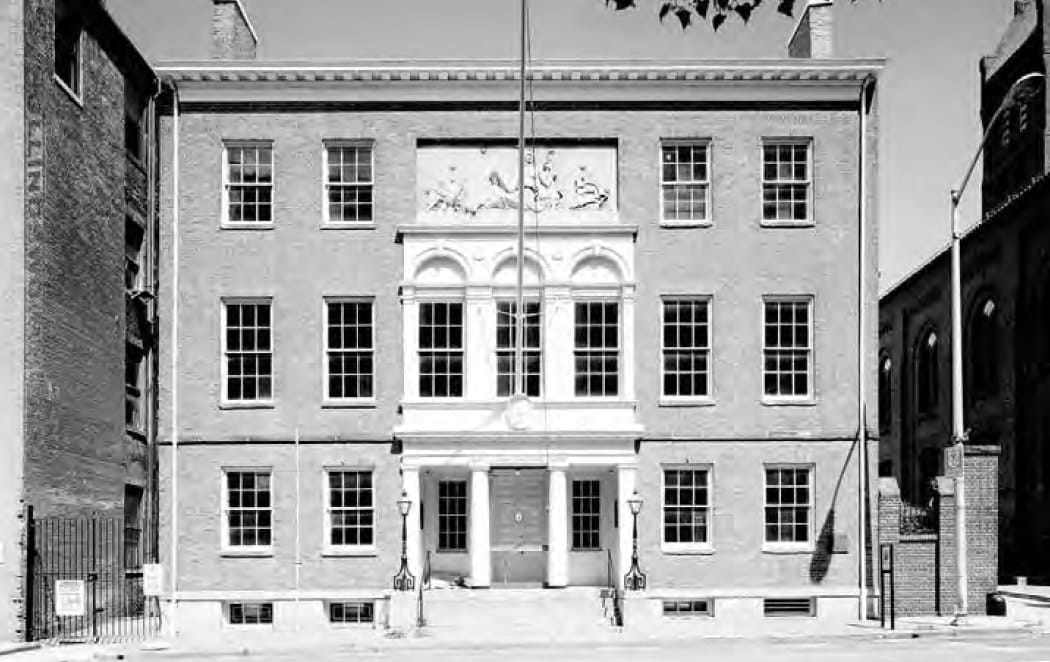
The rebirth of the Peale began in 1929 amid Baltimore’s bicentennial celebrations. With the support of Mayor William F. Broening, the city undertook a restoration of the aging structure. Architect John F. Scarff sought to return the building to its early 19th-century appearance, incorporating salvaged architectural elements and carefully reconstructing missing details.
The Municipal Museum of the City of Baltimore opened to the public in October 1931. For more than six decades, the Peale Museum interpreted the city’s history through exhibitions, lectures, and community programs. Under director Wilbur H. Hunter and others, the museum became a leading voice in historic preservation, advocating for the protection of Baltimore landmarks during the era of urban renewal.
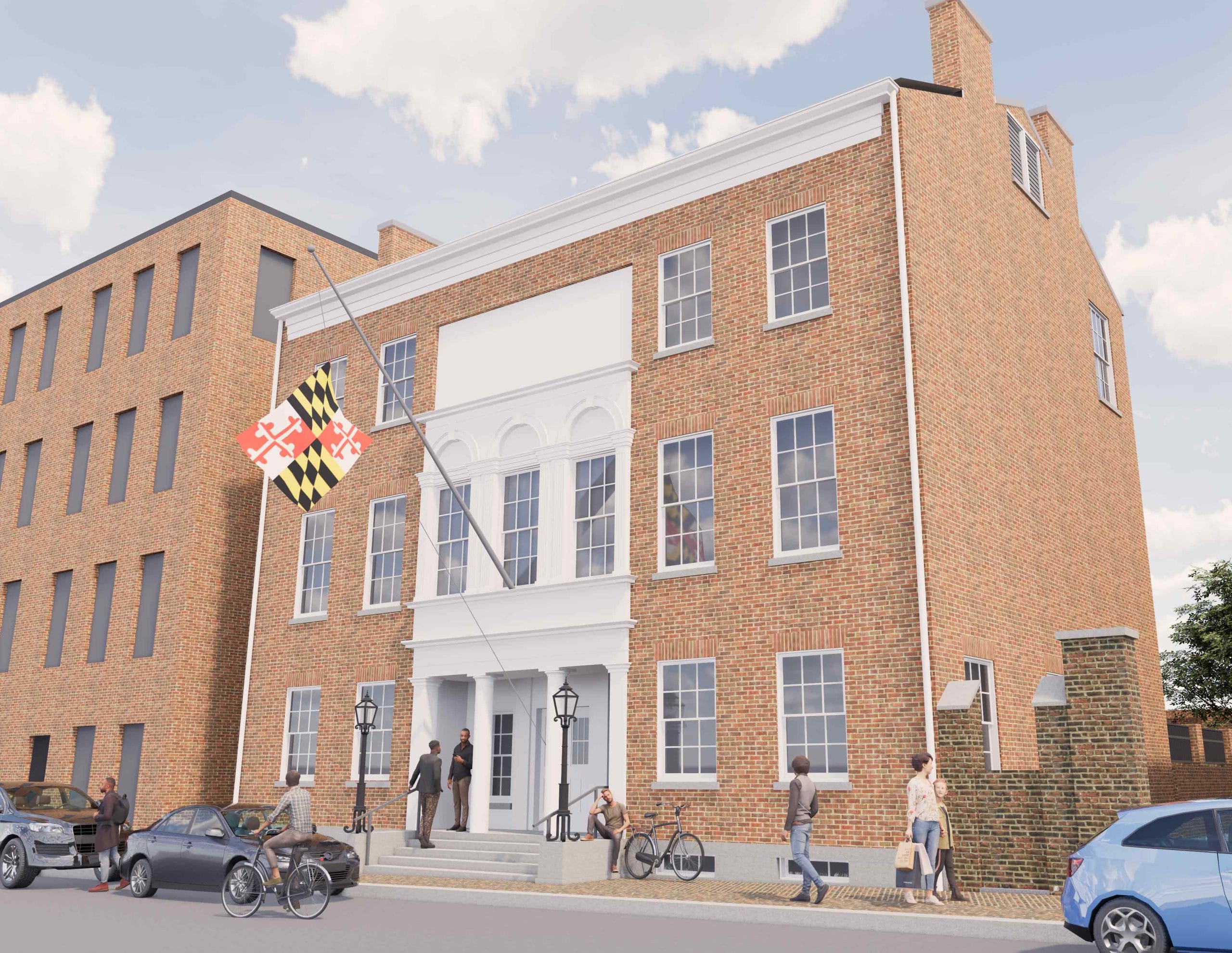
Following the closure of the Peale Museum in 1997, the building stood largely vacant for nearly two decades. Though occasionally used as a conference space, it lacked sustained programming or funding for major repairs. Deferred maintenance and structural concerns once again raised questions about its future.
In the early 2000s, a group of Baltimore residents formed the Friends of the Peale to advocate for the building’s preservation and reuse. By 2012, this effort resulted in the creation of the Peale Center for Baltimore History and Architecture, a nonprofit organization dedicated to restoring the landmark and reimagining its purpose for the 21st century. Through persistent fundraising and public advocacy, the groundwork was laid for a comprehensive rehabilitation.
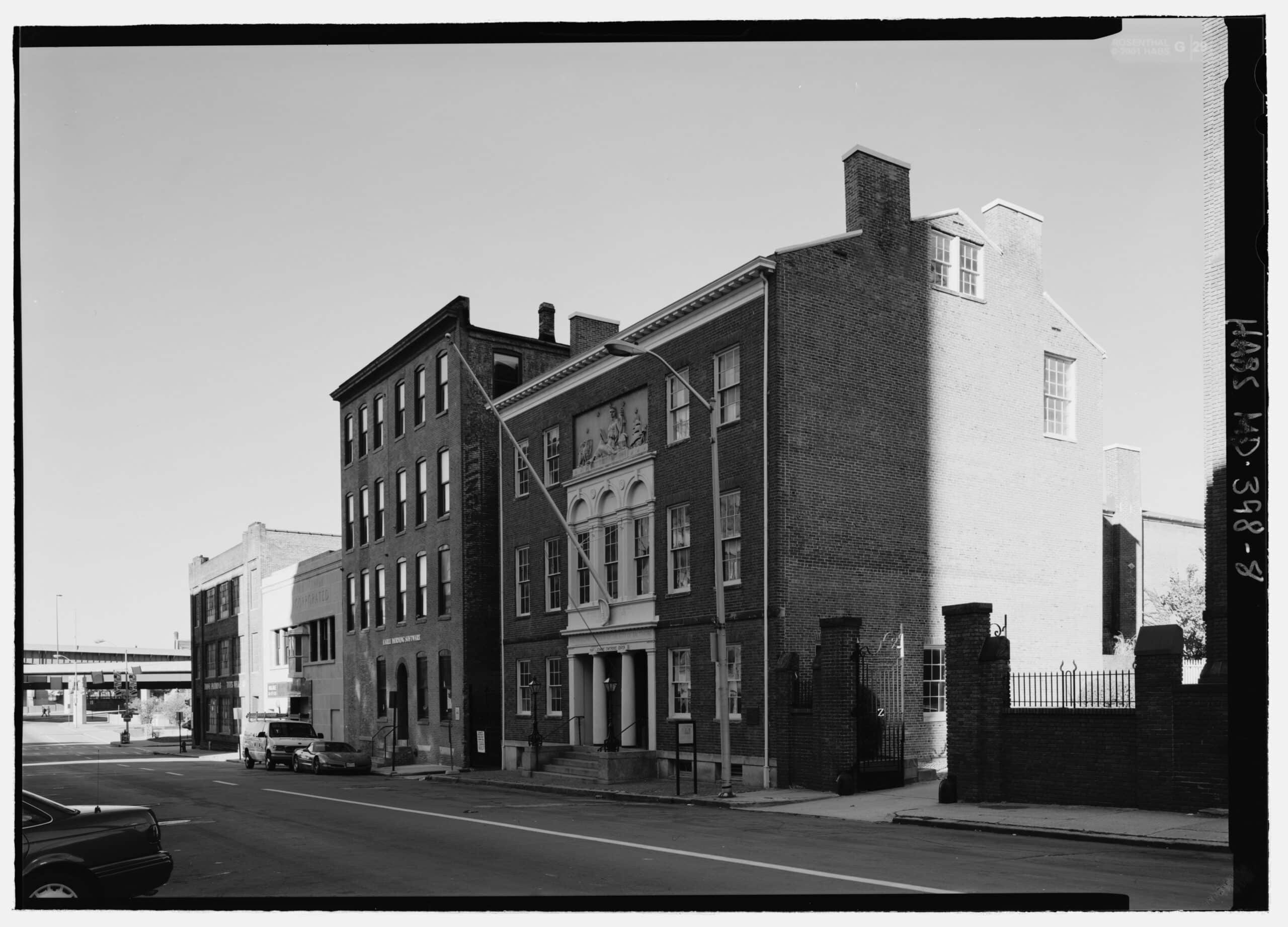
By 2012, the future of the Peale building hinged not on memory, but on action. The newly formed Peale Center for Baltimore History and Architecture inherited a structure that was architecturally significant yet physically vulnerable. Roof failure, masonry deterioration, water infiltration, and outdated mechanical systems threatened the integrity of one of the nation’s earliest museum buildings.
Restoration required more than preservation rhetoric — it required capital. Between 2014 and 2018, the organization launched targeted fundraising campaigns to stabilize the structure. Grants and private donations supported installation of a new roof, exterior masonry repair, drainage improvements, and restoration of the historic garden space. These projects were not cosmetic; they were interventions that prevented irreversible damage.
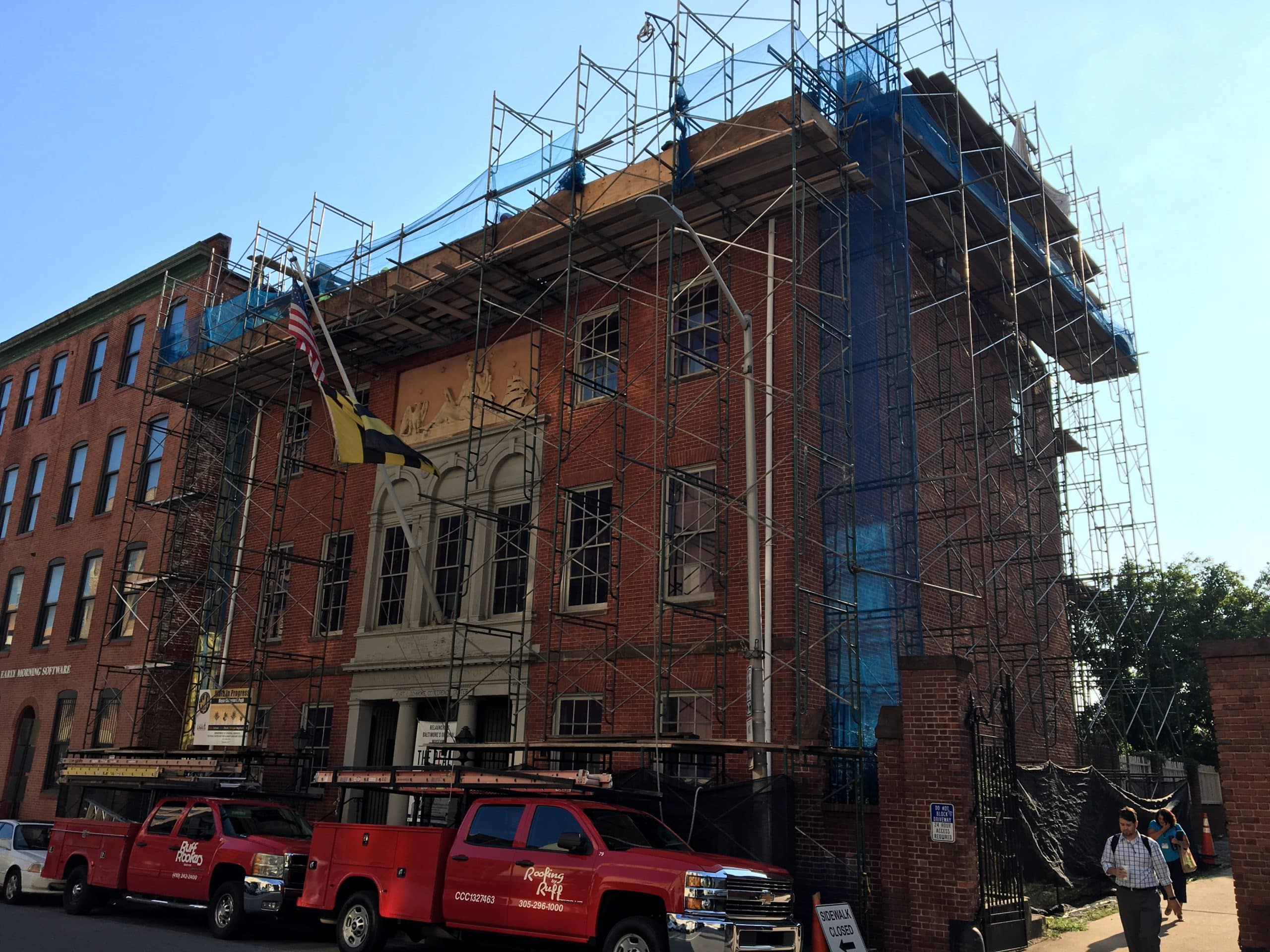
In 2018, comprehensive interior restoration began in earnest. Guided by preservation standards appropriate to a National Historic Landmark, contractors and conservators addressed decades of deferred maintenance while adapting the building for 21st-century accessibility and programming.
Major work included plaster stabilization, restoration of woodwork and flooring, structural reinforcement, updated mechanical systems, and installation of ramps and an elevator. These improvements were critical not only to code compliance but to equity — ensuring that the building could serve all visitors.
The restoration sought balance: preserving early 19th-century architectural character while allowing flexible contemporary use. The result was neither a frozen historic house nor a stripped modern shell, but a layered space that acknowledges its multiple identities — museum, city hall, school, factory, municipal museum, and now community museum.
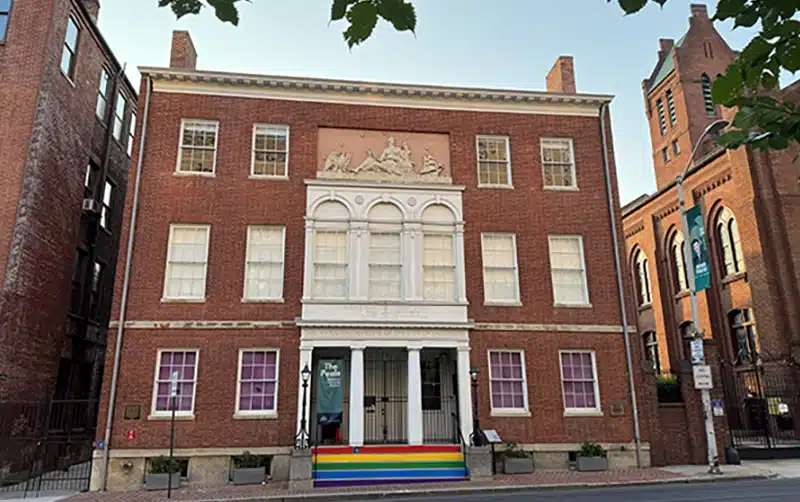
When the Peale reopened in 2020, it did so not as a conventional history museum, but as something more adaptive and participatory: Baltimore’s Community Museum.
The reopening marked the culmination of years of stabilization and restoration, yet it also coincided with the unprecedented disruption of the COVID-19 pandemic. Rather than delay its mission, the Peale leaned into flexibility. Programming expanded across digital platforms, exhibitions became more collaborative, and community voices moved to the center of interpretation.
Today, the Peale functions as a civic forum — a space where Baltimoreans gather to tell stories, debate issues, celebrate culture, and reflect on the city’s past and future. Its exhibitions are co-created with artists, historians, neighborhood leaders, and young people. Its galleries host oral histories, performance, visual art, and public dialogue. The building that once housed a museum of natural history, a city hall, a school, factories, and a municipal museum now serves as an incubator for shared civic memory.